
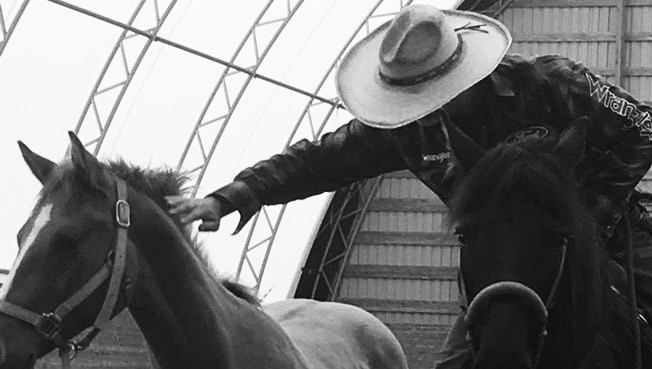
Catching a horse can be very challenging for some people – like trailer loading, catching a horse can tell you a lot about yourself, if you let it. There is an old saying that says something like “if you try to catch your horse in five minutes it will take you an hour, if you allow yourself an hour to catch your horse it will only take five minute“.
These two simple tasks will show what kind of a horse person you really are. I have heard a number of folks having trouble catching their horse say things like “when I get hold of that so and so I’m lay a beating on him – that’ll teach him I mean business“
I have similarly seen people struggle to catch their horses then after they finally get a halter on them they start popping the halter to punish the horse for being evasive. Ray Hunt, whom I never met, often said “THINK” – and obviously the people I just described are not thinking at all.
The horse has no idea what he did wrong, but after being punished for getting caught he darned sure won’t want that to happen again. There is a problem, the cause of it and how it is perpetuated – so what is the solution:
The solution lies in “preparing your horse to be caught” – and of course that does not mean showing up with a pocket full of carrots. There must be something in it for the horse, something pleasurable and rewarding.
This video link is a perfect on-point insight in how to develop a draw on your horse to where your horse starts to want with you, in fact it will start to follow you, to seek your touch. In the case of the video this was accomplished by round penning the horse – not in the sense of the children’s TV Show Heartland where the horse was run into total submission.
A round pen isn’t necessary to create a draw, what is necessary is to develop an awareness of how much pressure your horse will tolerate. If you are observant enough, your horse will let know how much pressure it will take before they move away. And when they do, the wrong answer is to follow them, to try to close the gap.
Practice timing backing off pressure, do it when the horse is looking at you, not when they are marching away. Think about how you are presenting yourself to your horse – are you acting like a predator (going straight at them) can you use angles to walk parallel to them? If you can find the distance at which the slightest flight response is triggered back off a yard or two to see if that makes a difference.
If your horse is okay with you being twenty feet away use that distance to walk a circle around the horse – so it can catch you out of each eye. As the horse remains in place slowly continue making concentric circles around the horse and observe the changing tolerance. When you are close enough to almost touch the horse raise you hand slowly gesturing your intention to scratch the horse’s nose.
When the horse looks directly at you back off a step to see if you can create a draw from the horse if not repeat the process from the closer proximity until you do. Rather than standing your ground continue to move in your concentric circles until you are even closer, ideally with the horse now following you.
This is the wrong time to suddenly reach for the horse, that will take you right back to the beginning, rather just try to gently touch the horse’s nose, being mindful at this range his eyes cannot converge on you hand. He knows your hand is there but he cannot see it, he must investigate with his nose – so be sure not to startle him. Gently touch his nose then retreat a little, maybe half a step.
This behaviour will cause the curious horse to investigate further – you may need to repeat the nose touch several times, before he will allow you scratch either between his eyes or on his cheek. Continue with the very small touch and release process until he starts to seek the comforting feeling of the touch, especially on the side of his wither/shoulder area.
As he becomes more tolerant (it is not immediate)reach over the neck to scratch the other side while maintaining your position. You will need to be able to do that in order to place the halter around his neck.
Key elements to success with this method:
1. Don’t be in a hurry – it will take longer. 2. Do this on your own, more people equals more perceived risk. 3. Do not ever weaponize your halter and lead rope as a tool to throw over the horse’s neck – your horse will only recognize your intention to capture him aggressively if catching him has become an unpleasant experience. 4. Train yourself to recognize even the smallest try by your horse.
The first time you do this it will take a while – plan on an hour, but repeating the process each consecutive time will make it easier and easier developing into a willing arrangement. For many people, even those who have owned horses for many years, there exists an unjustified fear of being around horses.
If you have other people sharing your turnout your horses may be exposed to undue pressure from people who do not know how to handle horses at the gate. You can manage this by your own consistency, the horse will differentiate between people who treat him harshly and those who do not. Encourage the fearful types to read books, watch videos and attend at horsemanship clinics. But be mindful that not all clinicians are good horsemen – many are proven in particular sports, but lack good horsemanship skills.
If their training involves the use of whips, chains, harsh bits and more discipline and correction that reward – find someone else. If you live in Southwestern Ontario quality horsemanship is rare. Once you have developed an understanding with your horses, catching them can become as easy as in this video. But to be fair, while this works most of the time, there are other times when I still need to go to them – sometimes the grass is just too alluring, and they’d rather not leave it.